

In the courier and parcel industry, risk rarely comes from a single point of failure. It builds across every handoff, transfer, checkpoint, partner, and geography involved in moving a shipment from origin to destination.
A parcel may be picked up on time, delayed in transit, transferred between multiple carriers, held at customs, or delivered with damage. At every stage, new operational, financial, and reputational risks emerge. And when something goes wrong, the real challenge often begins after the event itself: proving what happened, when it happened, who was responsible, and whether service obligations were actually met.
This is where traditional systems begin to show their limits.
Many logistics operations still rely on centralized platforms, fragmented databases, manual updates, and records that can be delayed, disputed, or interpreted differently by each stakeholder. In an industry where trust, accountability, and speed are essential, that creates a deeper structural gap — not just in visibility, but in verifiability.
Blockchain changes that.
By introducing an immutable shared ledger across the shipment lifecycle, blockchain creates a single source of truth that all authorized parties can rely on. Every key event — pickup, scan, transfer, delay, exception, and delivery confirmation — can be recorded as a cryptographically secured transaction. Once entered, that record cannot be altered without leaving a trace.
The result is a tamper-proof chain of custody that strengthens operational trust from end to end.
Instead of relying on disconnected systems and after-the-fact reconciliation, courier and parcel businesses gain a verifiable history of every shipment movement. That means fewer blind spots, faster issue resolution, and a much stronger foundation for managing risk proactively rather than reactively.
Why immutable trust matters in courier and parcel operations
Risk management in logistics is fundamentally tied to visibility and accountability.
When records are fragmented, teams spend valuable time investigating disputes, validating timestamps, matching partner data, and determining liability. This slows claims handling, weakens SLA enforcement, and creates friction between carriers, partners, insurers, and customers.
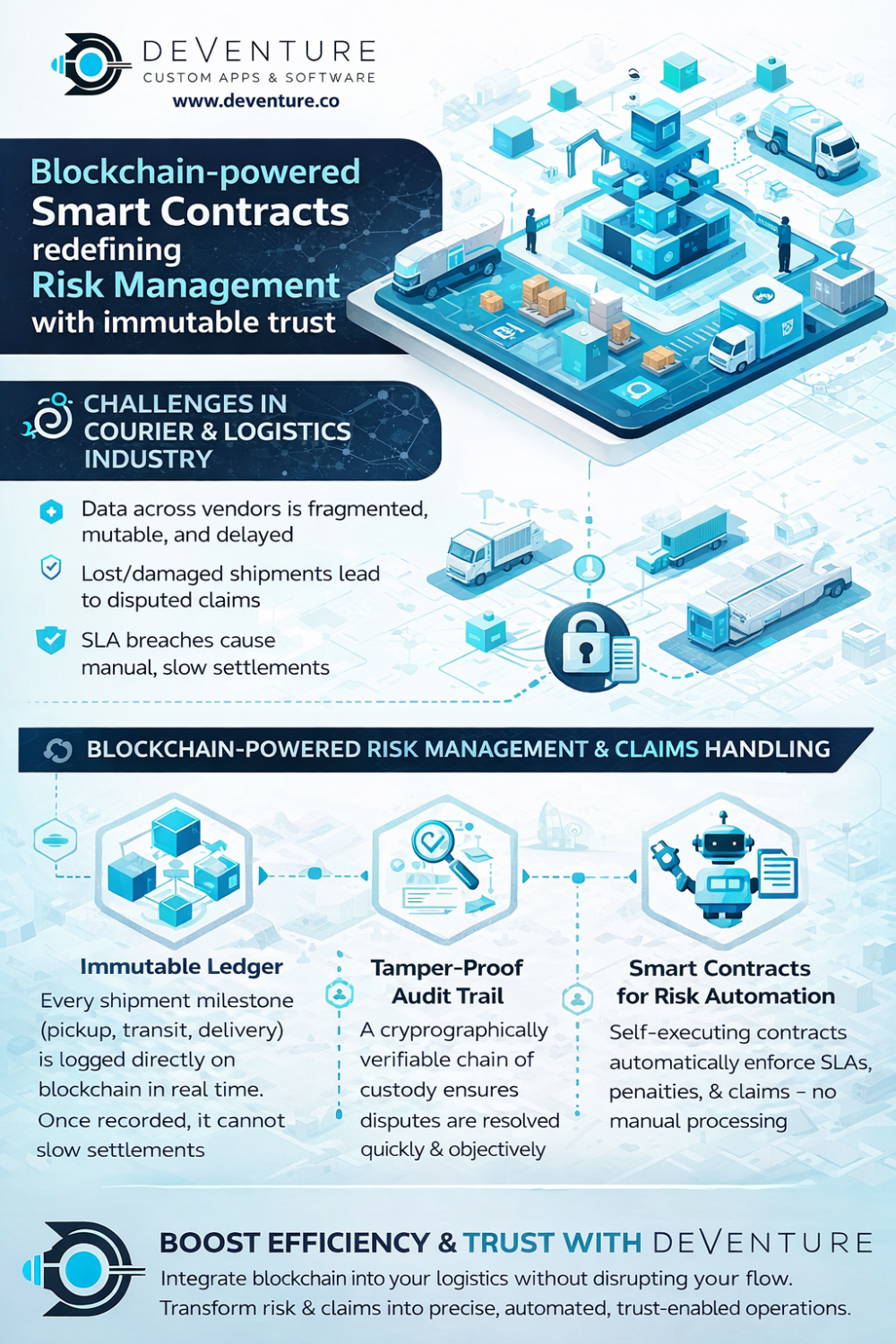
Blockchain addresses this by making operational events transparent, time-stamped, and independently verifiable.
That has direct implications for:
- Shipment traceability
- Proof of handoff and delivery
- Damage and loss investigations
- SLA monitoring and enforcement
- Partner accountability
- Claims validation and settlement
With a blockchain-backed model, each shipment event becomes part of a trusted operational record. If a parcel was delayed at a transfer hub, the timeline is visible. If custody changed between partners, the handoff is recorded. If a delivery condition was not met, the evidence is already there.
This reduces ambiguity and replaces contested narratives with verifiable facts.
Smart contracts move risk management from manual to automated
While blockchain provides the trusted record, smart contracts bring automation to the decision layer.
A smart contract is a self-executing set of rules built on top of blockchain. When predefined conditions are met, it automatically triggers the agreed outcome.

In the courier and parcel industry, this opens the door to a far more responsive and efficient risk management model.
For example, smart contracts can be designed to:
- Trigger SLA penalties when delivery windows are missed
- Release payments once delivery is confirmed
- Initiate claims workflows when damage events are logged
- Notify stakeholders when timing, route, or handling exceptions occur
- Validate whether contractual service conditions were fulfilled
- Reduce manual review in repetitive dispute scenarios
This is especially valuable in high-volume environments where manual intervention creates delays, inconsistency, and unnecessary cost.
Instead of waiting for teams to review fragmented evidence across multiple systems, organizations can create rules-based, self-executing workflows that respond in real time. That means faster claims processing, clearer accountability, and stronger service governance.
A stronger model for claims handling
Claims management is one of the areas where blockchain and smart contracts can create immediate operational value.
In many courier and parcel ecosystems, claims are slowed down by incomplete records, conflicting partner data, and manual validation processes. This often leads to long resolution cycles, customer dissatisfaction, and administrative overhead.

With blockchain, the audit trail is already built into the shipment lifecycle.
Every event is recorded in sequence. Every handoff is traceable. Every exception can be linked to a verified timestamp and responsible party. That creates a forensic-grade audit trail that removes subjectivity from the validation process.
Smart contracts can then automate the next step.
If a shipment arrives outside the agreed SLA window, a contract can automatically flag non-compliance. If damage is confirmed under predefined conditions, the claims workflow can begin instantly. If all supporting criteria are met, compensation or escalation can be triggered without waiting for lengthy manual review.
This creates a more scalable, transparent, and reliable claims system — one that protects both operational efficiency and customer trust.
Integration is what makes adoption practical
Blockchain does not create value in isolation.
For courier and parcel businesses, the real opportunity lies in integrating blockchain capabilities with existing logistics ecosystems — including transport management systems, warehouse platforms, parcel tracking tools, ERP environments, customer portals, and partner APIs.
That is where implementation strategy matters.
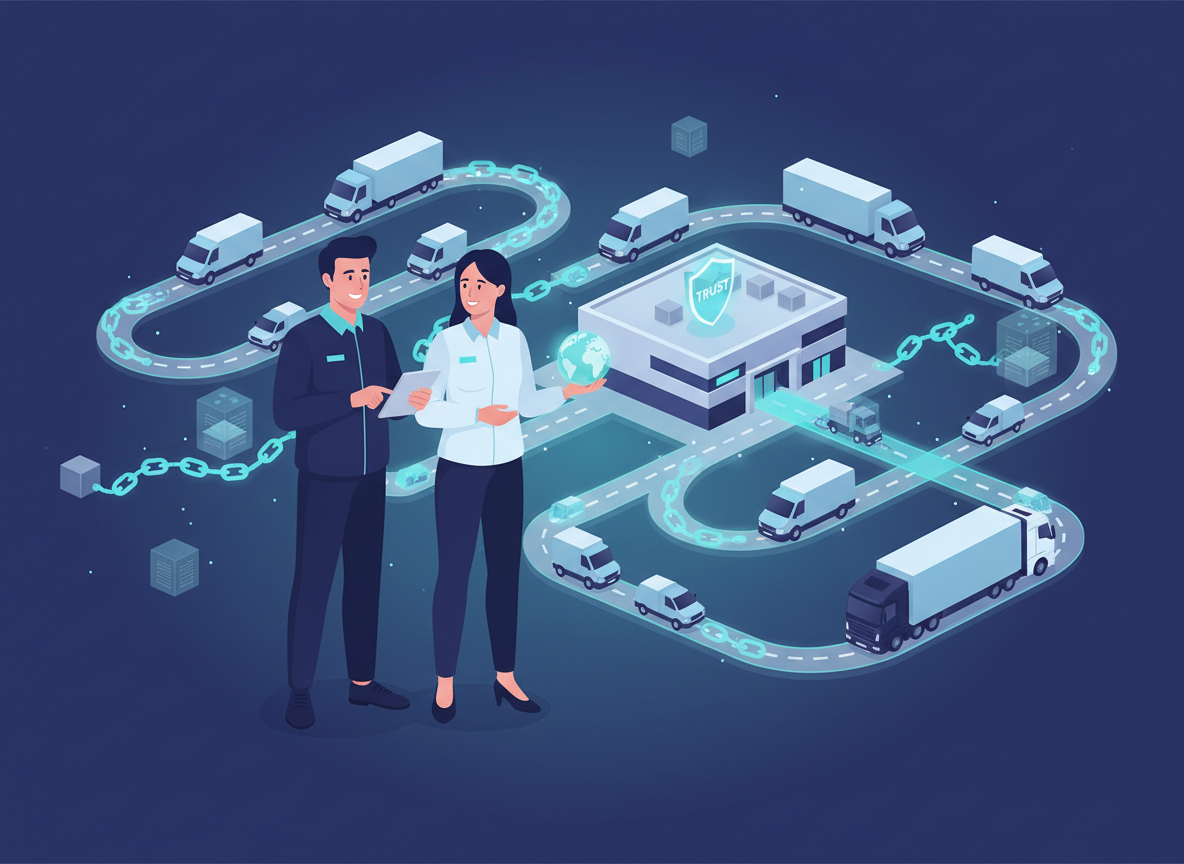
At Deventure.co, we help businesses bridge innovation with operational reality. Our strength lies in building scalable digital products that work within real business environments — not alongside them.
With our strong .NET foundation, API-first approach, and fully in-house capabilities across UI/UX, software development, and QA, we design and deliver solutions that connect modern technologies like blockchain with the systems organizations already depend on.
This matters because successful digital transformation is not about replacing everything. It is about creating the right architecture to improve trust, automation, and performance without disrupting the business.
In logistics, that means enabling blockchain-backed workflows that integrate seamlessly into day-to-day operations, support enterprise scalability, and deliver measurable outcomes.
From fragmented records to trusted operations
The courier and parcel industry is under constant pressure to move faster, reduce disputes, improve accountability, and deliver better customer experiences.
Blockchain and smart contracts offer a practical path forward.
They replace fragmented records with a shared, immutable source of truth. They transform claims and SLA enforcement from manual processes into automated workflows. And they create the kind of operational trust that modern logistics networks increasingly require.
The shift is no longer theoretical.
It is about building logistics systems where trust is embedded into the process itself — where every event is verifiable, every obligation is measurable, and every outcome can be executed with greater speed and confidence.

At Deventure.co, we see this as more than a technology conversation. It is a business transformation opportunity.
And for courier and parcel companies ready to modernize risk management, strengthen chain-of-custody visibility, and automate service accountability, blockchain-powered smart contracts are becoming a serious competitive advantage.

Blockchain builds trust. Smart contracts enforce logic. APIs drive scale.
That is how the next generation of logistics systems will be built.